
Flip phones, Southernality, and Jeboni Ashanti
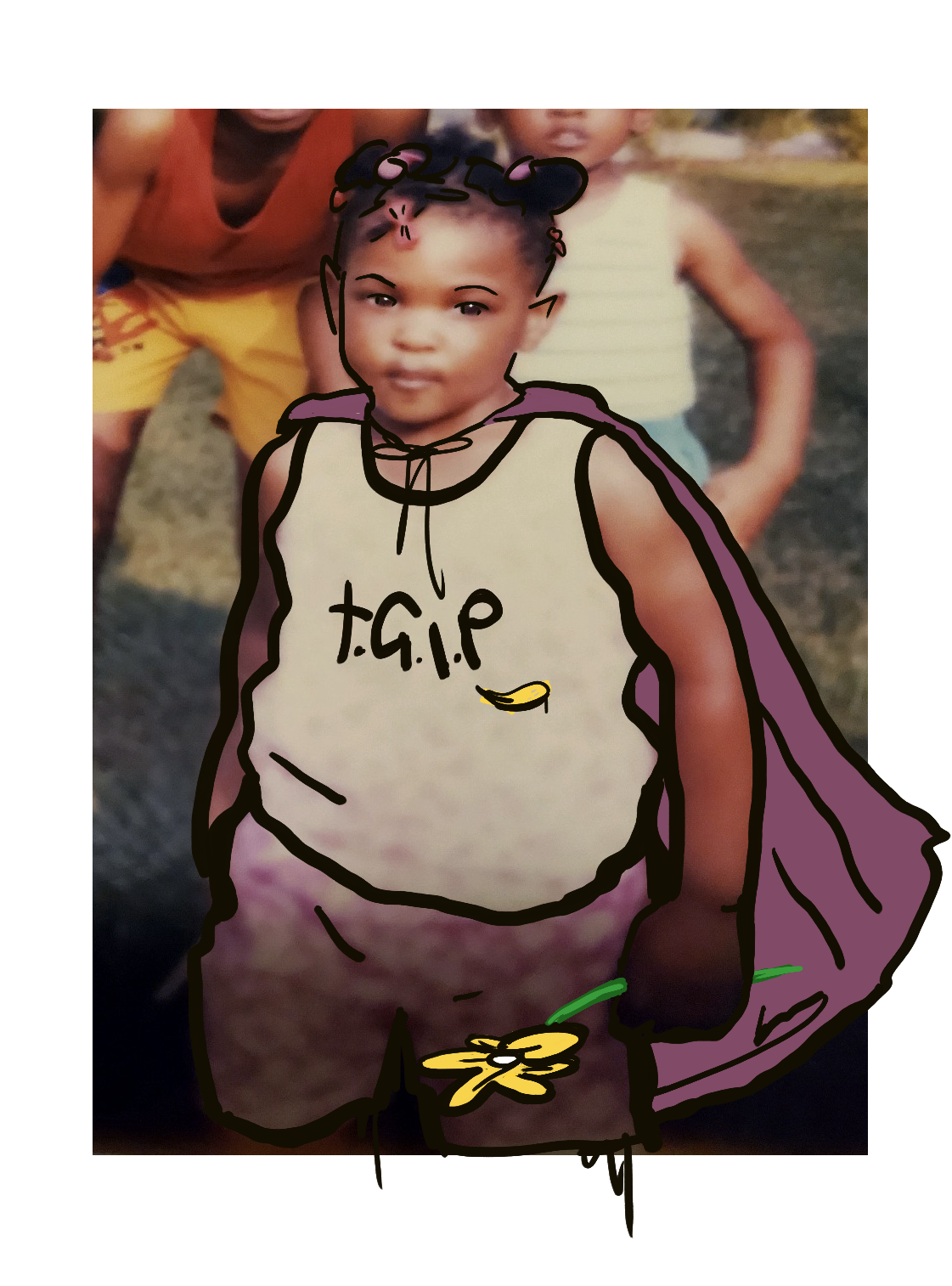
If there’s anything Jeboni Ashanti wants you to understand about her art, it’s a ‘return to self.’
T.G.I.P
Jeboni Ashanti is starkly against labels- she barely likes to be called an artist. “I’m a creative being, let’s say that.” But the other label that she will claim? Southern. Born and raised ITP on the East side, Ashanti leans into the style of the city that’s always loved her back.
She sees it represented in her various visual forms of expression as a multi-disciplinary creative. Along with a past in film and television production, Ashanti has left her spray-painted sunflower iconography in the form of murals in places like The S.W.A.T.S in Triton Yards, Sylvan Hills, East Atlanta EAV Village, and Southside. “I use sunflowers as the motif across my works due to sunflowers' beauty, healing effect and meaning. Sunflowers follow the sun from sunrise to sunset and when they can not find the sun, they face each other. It’s about being The Light. The single petal I leave behind is The Reminder.”
A long-time lover of Outkast, a reminiscer of the energy the city held during the ‘96 Olympics, an ‘all flats only!’ rep and ‘Decatur where it’s Greater’ believer, Jeboni Ashanti is almost ATL personified. If “The South got something to say!”, Jeboni Ashanti is saying it.
However prominent her work is now, art isn’t something she grew up knowing she could pursue professionally. “I was a mail-carrier for USPS for 9 years, then stepped into film and television for about 4 years. Creating is something that has always been a part of me, just something that has been more so pushed aside, due to being raised from the old school mentality of working class people, job security type jive. Growing up art was just something you did in your free time, kinda held in the view of not necessarily holding value to provide a sustainable living to make it in society.”
She credits her grandmother, Sadie’s, incredible work ethic and space for her own creativity; “When she wasn't cleaning homes and raising white folk’s kids, or working at the hospital, working 3 jobs at once, she somehow was always sewing- making something by just eyeing it. Whether it was upholstering a couch, clothes from scratch for the entire family and community, drapes for the windows, all the way to baking these grand wedding style cakes.”
As well as her grandmother Sadie, Ashanti has held onto the words of her grandfather on her dad’s side, “find a job you can do with your hands, and you’ll have a job for life.” Ashanti also holds onto another piece of her grandmother’s words, “My grandma Sadie would always say “If GOD shows me, then I could do it!””
When Jeboni Ashanti first walked into Gallery Anderson Smith, a red wagon trailed behind her swaggering stride. Ashanti was dressed like a true ATLien, had the relaxed demeanor and gentle southern drawl to match. The red wagon contained two pieces: her rendition of Ernie Barnes’ masterpiece “The Sugar Shack” called “The Party Must Die,” and a soon-to-be stretched portrait of her mother called “Prototype.”
The first piece was the reason she was here- we had sent out a submissions call for our Black Art Exhibition “ELECTRIC WORD” and she sent in a photo of “The Party Must Die.” The piece takes all the same form, technique and movement as “The Sugar Shack,” we were in awe of how delicately and masterfully she had captured Barnes’ style with ease. The movement, the colors, all to a perfect T. “The Sugar Shack” celebrates oneness, and invokes the history of the Black Music Hall in a joyful visual. Ashanti’s “The Party Must Die” lacks exactly that- there is no oneness or unity, there is no interaction between the figures, only with the phone in their hand as they perform for an unseen audience.
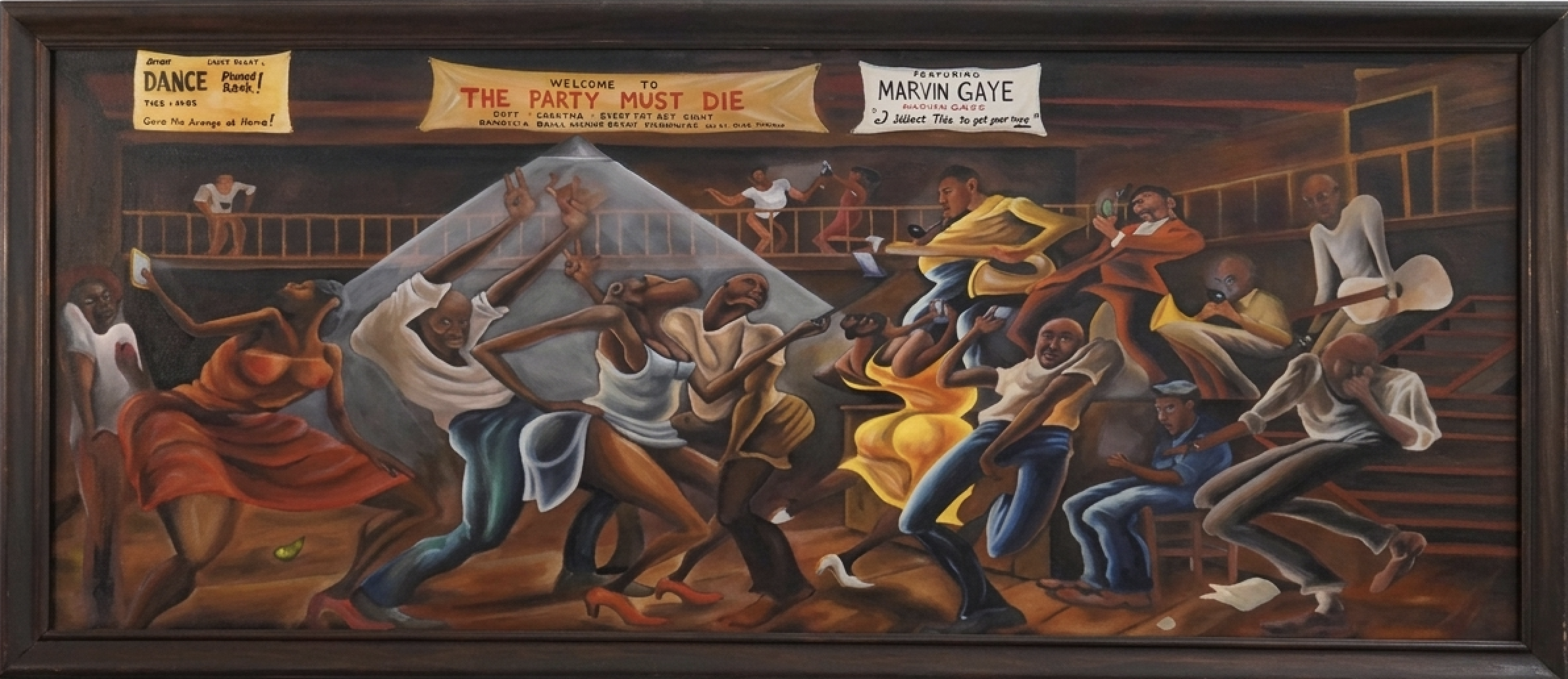
The Party Must Die, 2026
The idea of “Death of the Living Room,” circulates in the piece; the idea addresses the recent diminishing of a single household screen (the Television) as the only means to consume media through a screen, the end of a single, shared gathering place to experience a mass-cultural event. Now, we sit in our separate rooms, on our separate screens, refreshing and doomscrolling and not hearing a real human voice outside of that unless we seek it out. “The Party Must Die” showcases all of that: The end of the club experience, the end of “third spaces,” the end of community except for the sake of performance for our various personal screens.
“There’s so many easter eggs in the painting, and my goal is for the viewer to question themselves in that moment about their habits and or their peers' habits. To bring back in-person connection and community. Just like those Good Times of before.”
Her peers have taken to lovingly dubbing Ashanti as ‘Flip Phone Shawty,’ as she utilizes an old-school flip phone nowadays. “Why do we need a phone to prove we exist?” Asks Ashanti. She does still have her iPhone as a pseudo iPod for playing music and a gps (“If a playa gets lost!”), her iPad which is her only access to her socials, and films her posts on a DSLR camera. It separates her steps, keeps her off the screens for a while, and seems to be the modern version of “analog.” She believes the lack of her iPhone constantly on her person leads to a deeper self. “I just learned to operate with a healthier set of boundaries. Mindfulness and balance is key.”
However, she’s very aware of the importance of being connected as a visual artist. “Like, it’s a fine line, isn’t it? What started as a tool for connection has morphed into a machine for extraction. We got “The Attention Economy” where all the apps are literally engineered to trigger dopamine hits, turning our focus into a commodity and then that’s sold to advertisers. Like, we used to say our grace before we ate, now we take pics of our plates, upload them to social media and then we dig in. The erosion of presence- where we're often "somewhere else" even when we’re sitting right next to someone, fragmenting the actual human experience of being present,” she relents.
We speak about the art scene in Atlanta for a moment- is it just starting? Has it always been here? What is it? “Atlanta has a soulful voice- we’ve always been here.” She relays that social media has some to do with its recent growth, “Now there’s a lot more eyes on us.” New corporate buildings, new parks, an improving public transit system, the city that rises from the ashes seems to continue to do so. “Being inspired by Atlanta is an ever-revolving door. There’s just something beautiful always happening- in the arts scene, the music, Atlanta’s not a real place. You have to be here to understand it and truly know it.” In Ashanti’s eyes, Atlanta is a mix-tape always getting rewinded and remixed.
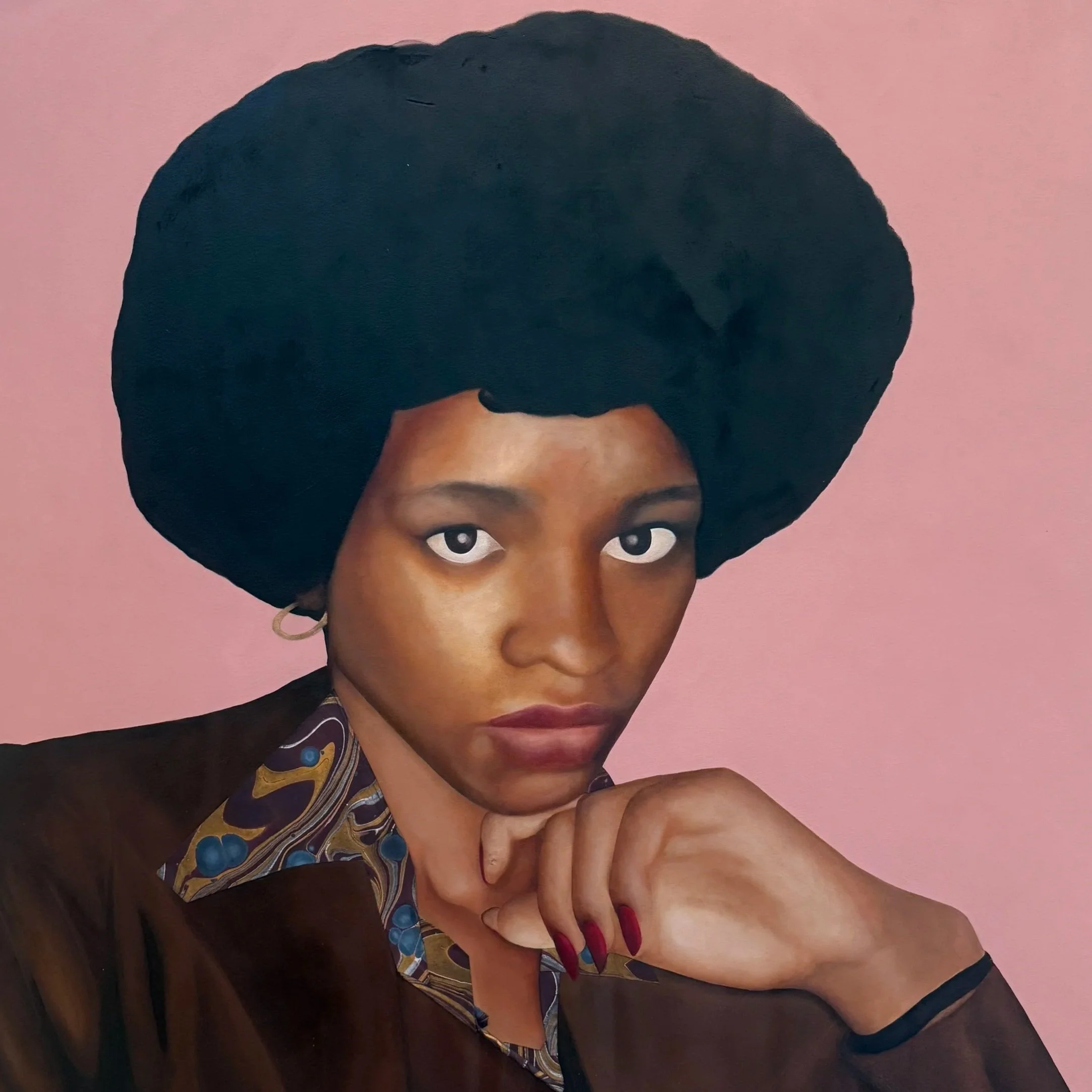
Prototype, 2026
Ashanti doesn’t seem to comment on anything in her work she lacks a personal connection to. In “Prototype,” the portrait takes after an image of Ashanti’s mother from the late 70’s or early 80’s. She is adorned in a rich brown suit jacket, a funky collar made of decor paper laying along her neckline. The whites of her eyes are striking to say the least- the warmth of the pink used for the liminal background situates her as almost an eternal being. She is in full charge of any and every interaction a viewer has with her, and she softly commands respect. Somehow, Ashanti has perfectly captured the powerful repose mothers have, without saying anything at all. “Protoype” is also one of the first instances she’s stretched and framed her own work, “I’m a sponge,” she says about learning. “So being a part of every process it takes to get artwork up on a wall has definitely changed my perspective on my artwork.”
“Us, you know, we’re Gods, lights, stronger than who we’re said to be.”
When asked why she decides to create these familial portraits, she has a quick answer. “I find myself creating in images of my people for that thing- that ‘return to self.’” She continues, “We’re all programmed as humans to constantly look outside ourselves, we’re all on autopilot most of the time. So the idea of ‘return to self’ is not only a true discovery of who I am, but who my mom is, who my dad is, you know. I grew up in a time where I couldn’t be myself- black, human, emotional, creative. I create in my parent’s image to honor them and who they are, especially at a time when they couldn’t be themselves either. Us, you know, we’re Gods, lights, stronger than who we’re said to be.”
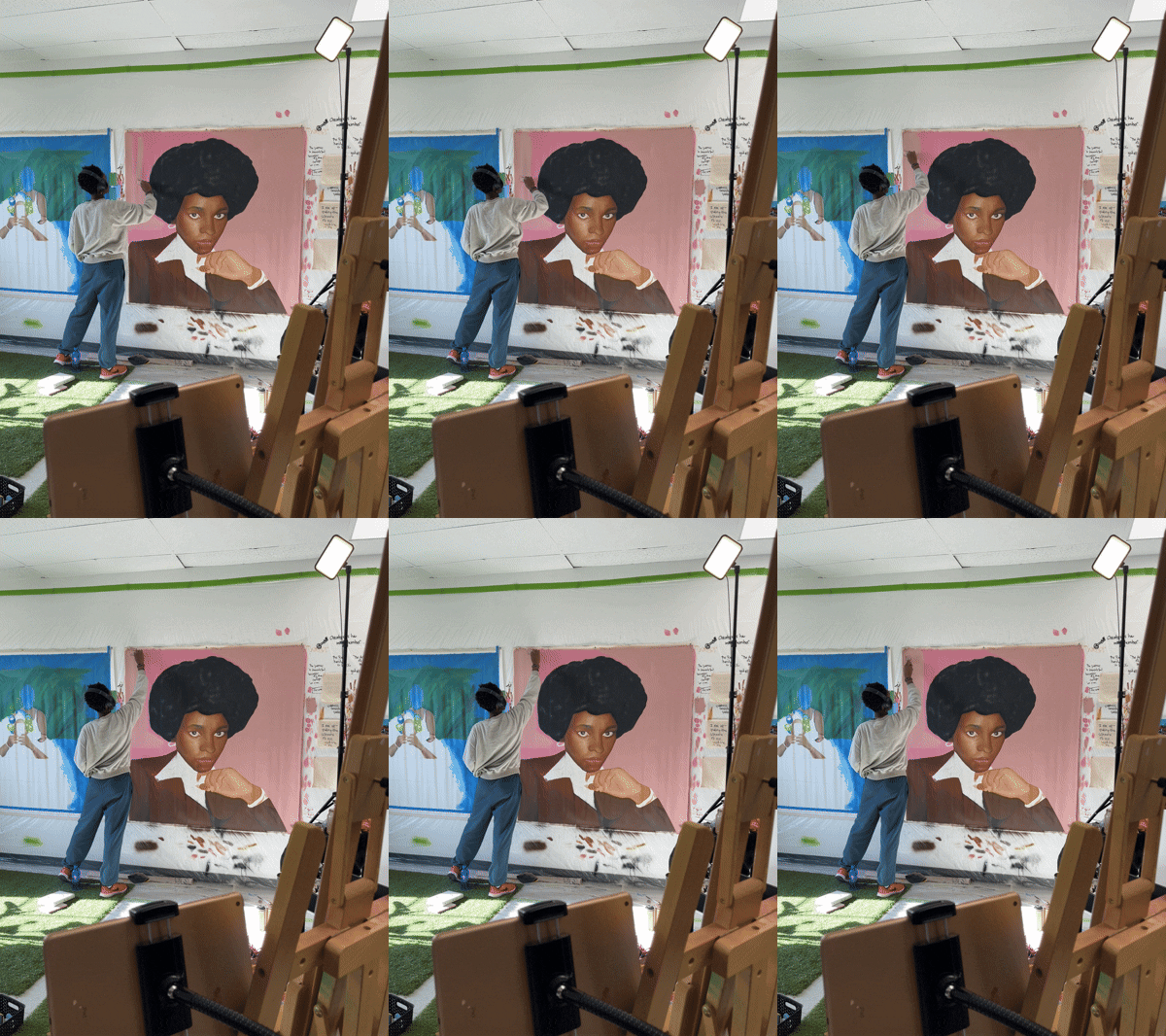
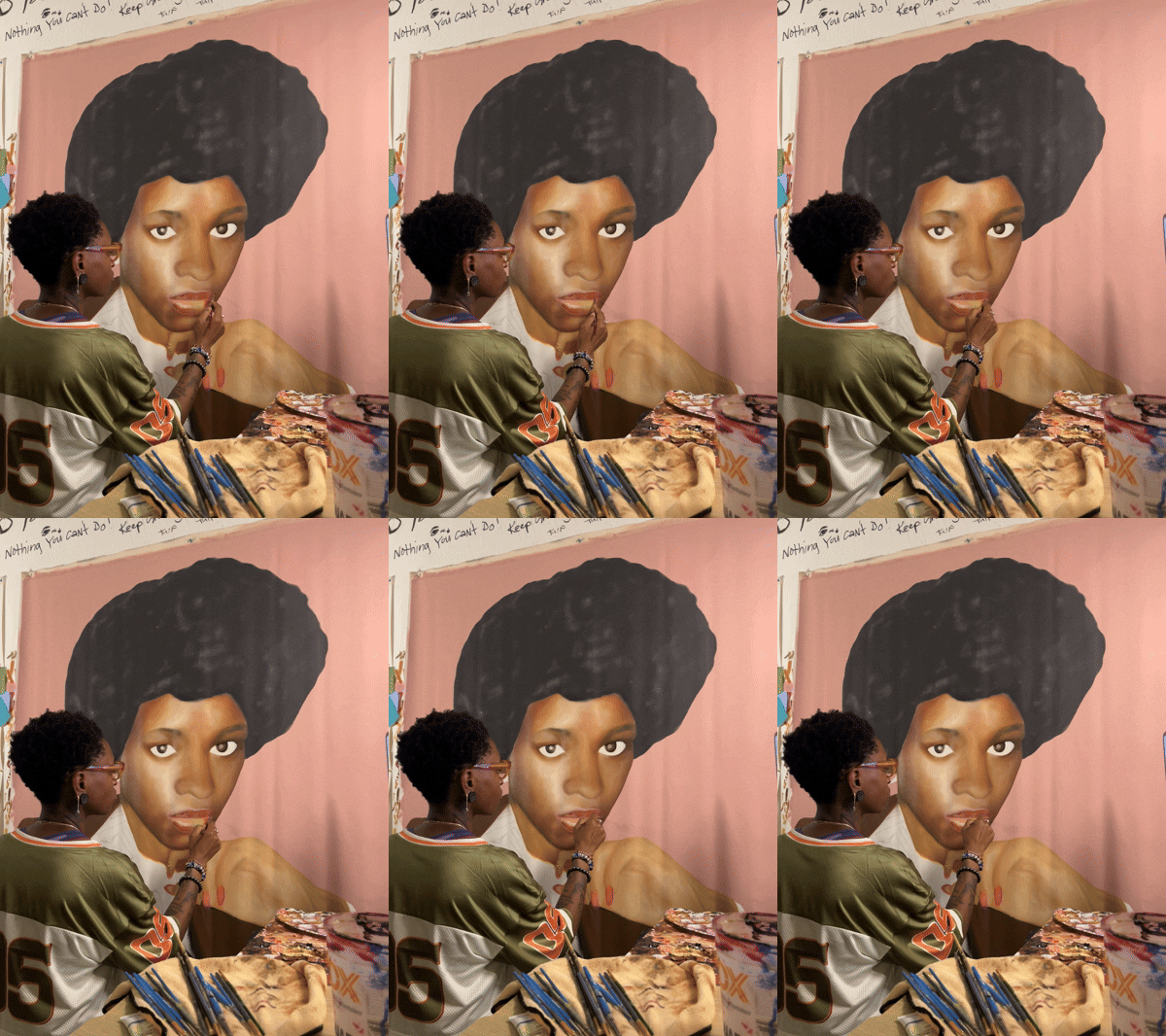
“I’ve been in a “return to self era” in my life, and with that return it is taking me through myself beyond birth. It’s leading me into a deeper dive of my family in a more intimate introspective lens of what shaped them, their habits and decisions. I am coming into a better grasp of understanding who, what, when, where and how in this current space and the role I am being called into in our bloodline. So, the current body of work that I've been creating in this upcoming collection, which “Prototype” is a part of, is my family’s re-introductory into the world. With these works I am aiming to exhibit the Black Familia Experience, in the midst of the constant oppression, suppression and forceful denial of who we are.” Ashanti lets us know the second piece to this diptych is in the works- in the image of her father. This new collection, Jeboni says, is named “We Were GODs All Along!”
“Prototype” has the listed mediums of charcoal, oils, spray paint and “GOD.” Her spiritualism weighs heavy on her creative process, her mantra and bonafide slogan is “TRUST GOD, ISSA PROCESS.” T.G.I.P stays splayed across her hats, her customized jackets and in her tags on her work. “Leave life in the process,” Ashanti says. “It’s a way of life, a way of existence for me. It’s a reminder, that in everything there’s a process, and when the water gets murky lean onto your Higher Self to navigate you through those troubled waters, so “Chill Jeb, You got this baby!””
It’s almost too universal and too ambiguous as a mantra at once. The process is creativity, the process is growing up, the process is everything all at once. And for Jeboni Ashanti, the process perhaps ends in a complete ‘return to self.’
“The works I ultimately create speak to my journey before, during and all the while. So, you may get something political from me, something that culturally resonates or something that just makes me smile, you know? As long as I reflect the times from a pure space as a true ATLien, I believe my job as a creative being...or artist they say,” Jeboni laughs, “is being fulfilled, and my younger self is proud.”
“Trust GOD, Issa Process.”
See Jeboni Ashanti’s work at Gallery Anderson Smith, and follow her here.
In loving memory of Hobo Ink. Rest in power.
Written by Camilla Schiappa April 2, 2026.