
10 Dimes, Iconic Narratives, and Scott Eichler
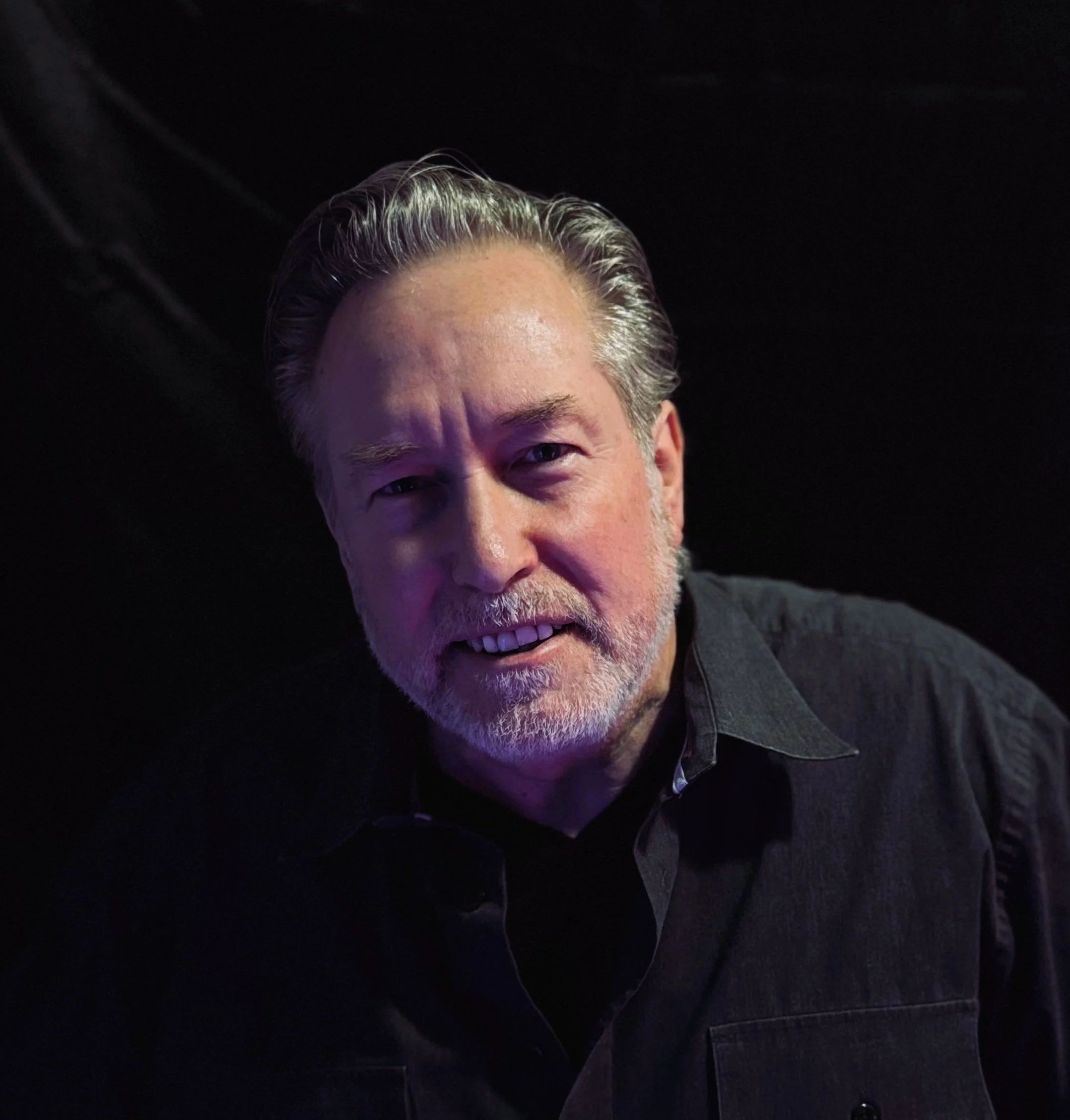
The artist, Scott Eichler
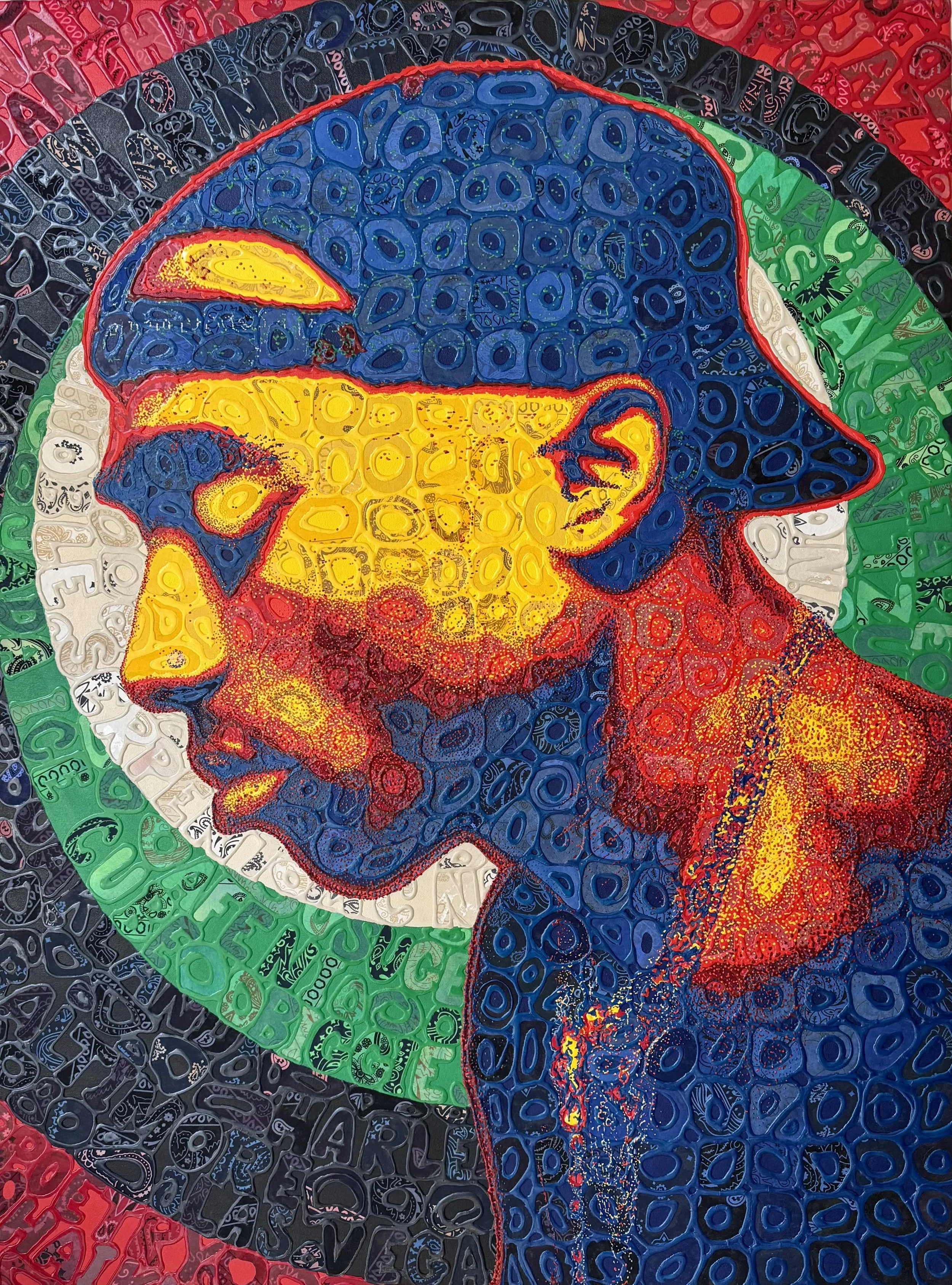
Having only been living and working in Atlanta for a few years yet, Scott Eichler made a splash with his two pieces, “TuPac: Spheres of Influence” and “JIMI: Mystic Muse” at our pop-art exhibition, “15 MINUTES.”
Each piece recollects the legacy of both figureheads depicted, done in a unique way the curatorial team at our gallery had not been privy to before. Eichler brandishes his immense knowledge of his icons through teeny signifiers he calls “winks” in each piece, like using hand-dyed bandanas in his TuPac piece, and mod-style velvet fabric in his Jimi Hendrix tribute. Looking closely at each artwork he creates, you start to realize you can only look closer.
To pick at his creative process, Eichler graciously agreed to an interview with the gallery.
Branding was/is a large part of your professional career before you started making and selling art. How do we see that represented in your artwork and your career as a visual artist?
Good branding requires deep research; curiosity aimed at enlightenment with a healthy dose of honesty. Perceptions develop whether they're intended or not, sometimes authentic and other times a manufactured veil. I also believe branding is a tapestry: emotions, story, materials, textures, even sheen, woven together with the standard visuals of images, colors and iconography. When taking on iconic figures, I immerse myself to understand them a little better - deconstructing the Hollywood creation or music industry hyperbole to see them as the authentic brand they truly are, while finding a balance with the fandom perceptions we all carry.
Can you explain the importance of the narrative in your work? How does the viewer put together the story of, for example, the TuPac or Jimi Hendrix piece?
I like art that has intentionality. Even when I just play, get messy, I'm always looking for a reason to stay inspired toward something intentional. This really peaks with the Pop Art portraits I do. There are plenty of skilled artists who can paint an image. I want my work to start a conversation. I want the collector to feel like they got to know the subject a little deeper, to actually see something in the subject they hadn't seen before. Of course I want to make visually beautiful work, but wrapping that up in a compelling story feels so much more complete to me.
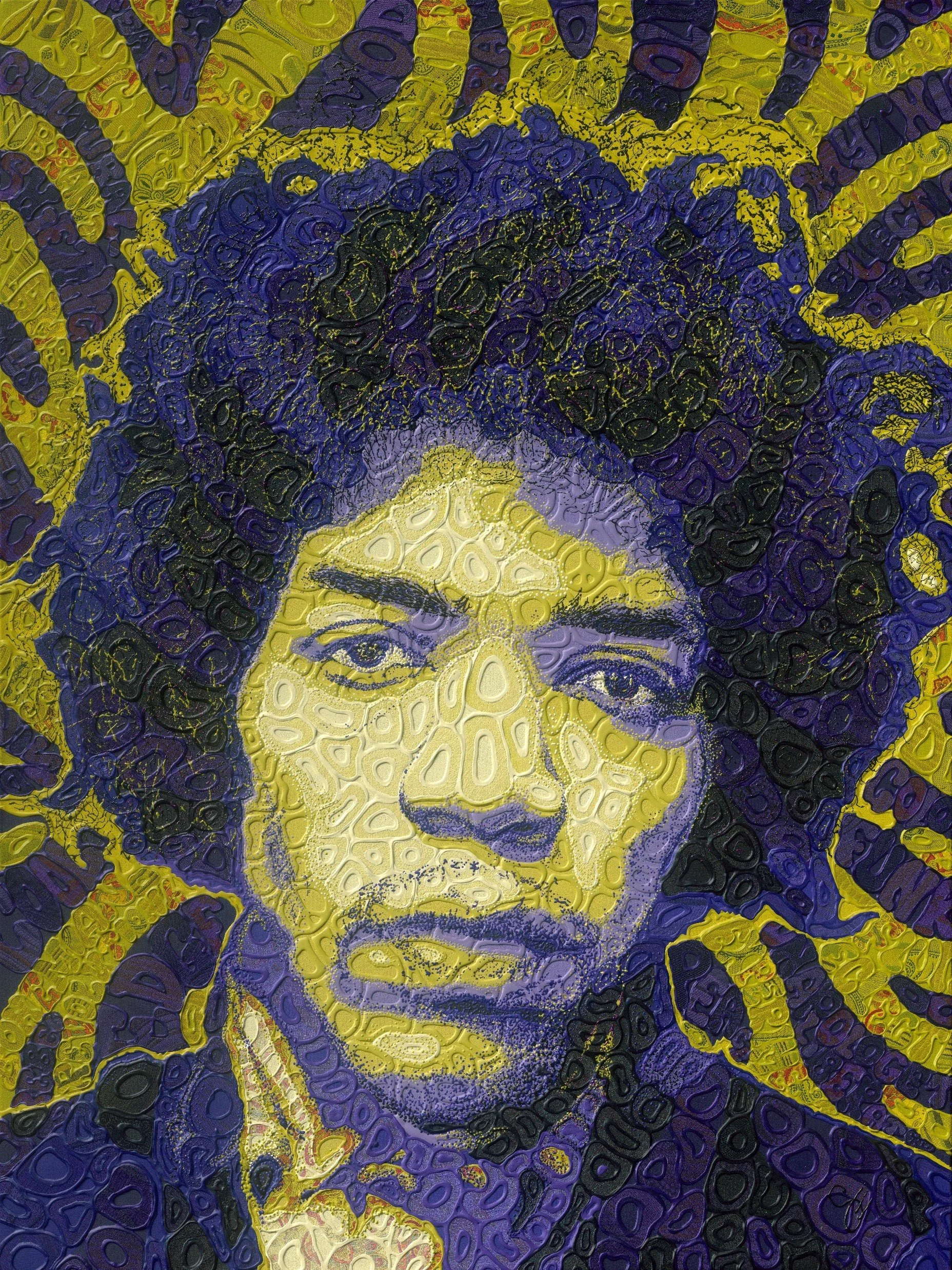
Do you prefer the visual narrative implications of a Jimi or TuPac portrait, or the abstracted narrative of pieces like “Life of a Dropcloth” ? Which is easier to create, in your opinion?
I love doing the pop portraits, but they can be a challenge. At times I've spent months searching for the narrative I want to pursue - reading books, internet rabbit holes, fact-checking, and eventually finding a story worth telling that hopefully brings something new. Then I need to figure out how I'm going to achieve that vision. When I did Tupac, I had never fused that many small pieces of fabric to a canvas, which led to a lot of experimenting.
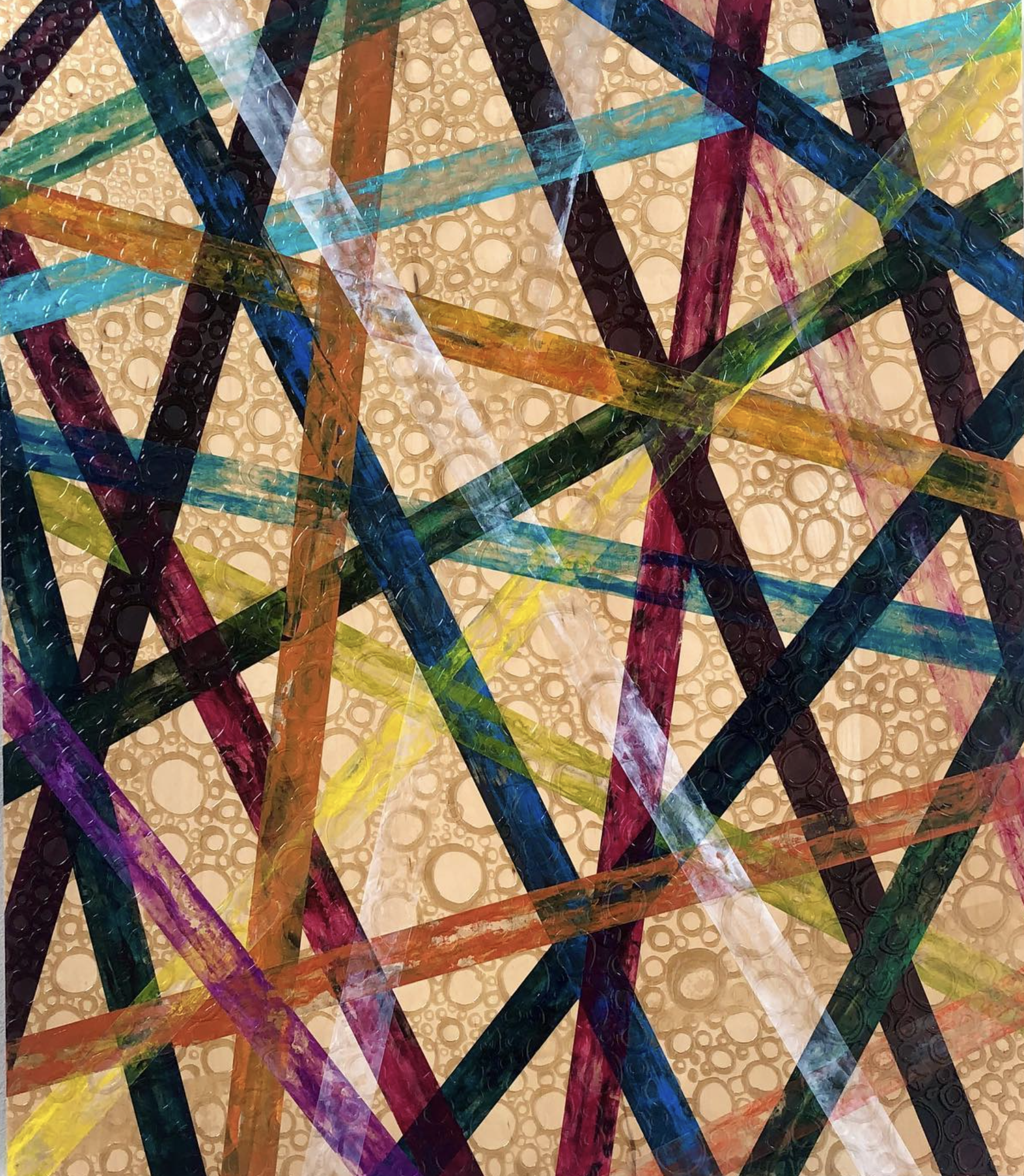
The abstract pieces are often more organic. "Life of a Dropcloth" is a perfect example. Originally I had no intention for it. I wanted to use a wide variety of bandanas dyed in different colors, so I was dyeing them with thinned-out paint and threw down a piece of canvas as a literal drop cloth while about 75 bandanas drip dried. It was messy but also intriguing, and I started to see it as a metaphor for his life. He had a messy early life, and I began layering thin transparent colors from the main painting in spheres over that messy start. Where Tupac: Spheres of Influence is specific about major influences in his life, from Shakespeare to Marin City, CA, "Life of a Dropcloth" is a more nuanced look at how all of our life experiences, layered over each other, create something beautiful, interesting and uniquely us - even with the messy layers underneath. I also use the more abstract works as a proving ground for different processes, and oftentimes what happens on an abstract piece directly informs the figurative ones.
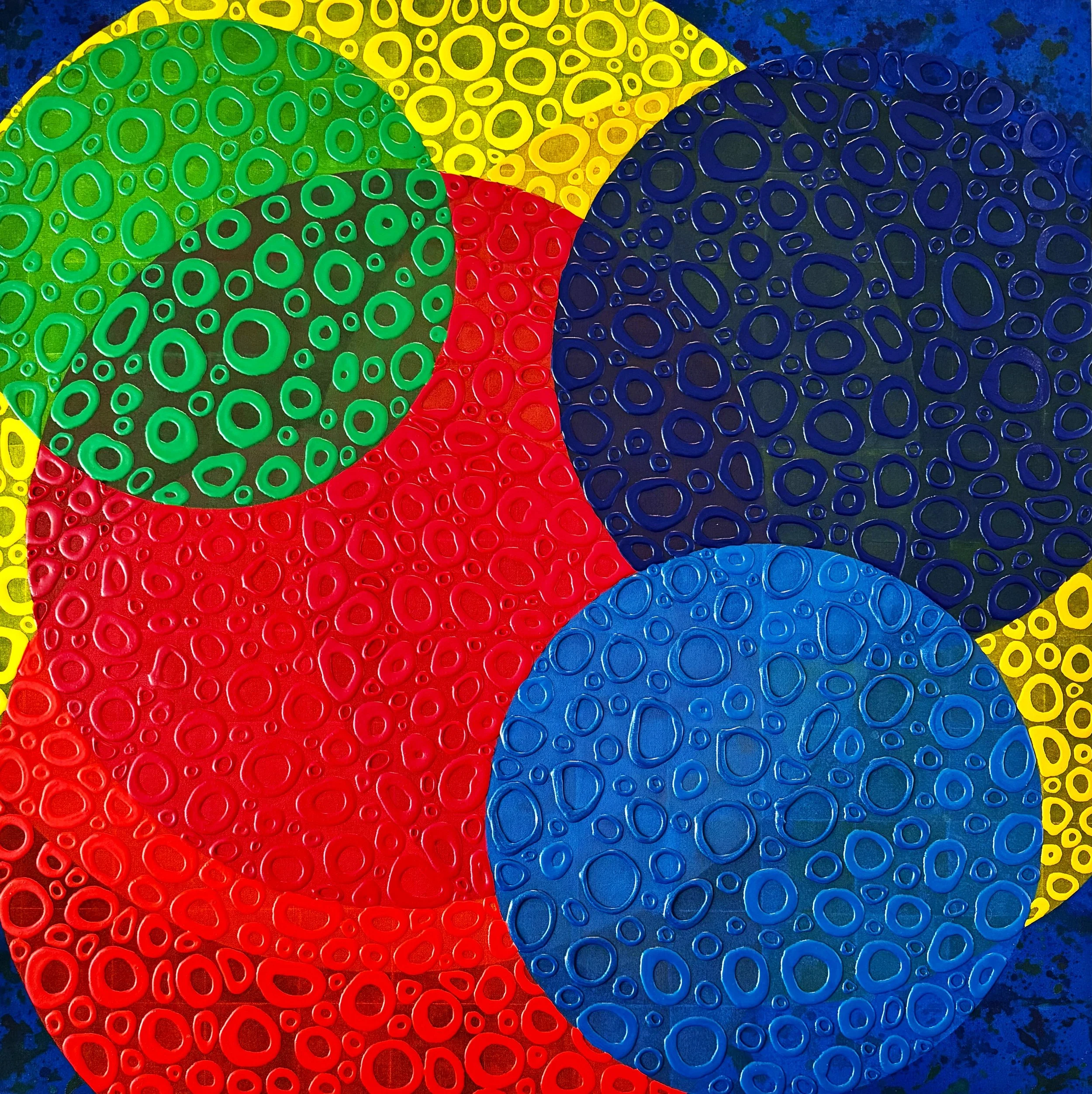
Life of a Dropcloth (2026)
You often use fabrics in your work, explain why fabric specifically as medium or texture is a through-line in your work.
I started out in the fashion business - merchandising, product development, textile design. I've always believed fashion is a part of everyone's personal brand; how you present yourself says a lot about you. That said, it has to feel like a part of the story. I don't just use textiles in everything. The first time I used them was in a portrait of Kurt Cobain. When Nirvana came on the scene, I was still in the fashion business, and overnight everyone was shopping at secondhand stores and flea markets. No one wanted our nicely designed washed denim or woven shirts. He was famously anti-commercialism, so when I painted Kurt it became a bit of a personal story too. I went around to Goodwill and secondhand stores, wondering to myself, "would Kurt be interested in this old shirt or this worn-out pair of jeans?"
Art is an all-encompassing term. Outside of the visual art world, what style or type of art speaks loudest to you?
I see great art influence everywhere, but I look to music and pop culture most. I have very broad tastes in music, and it so often shifts pop culture in ways we don't fully understand even while it's happening. There is always music playing in my studio: Mississippi Delta Blues, 70s Prog Rock, Jazz, current Pop, Alternative Rock, Hip Hop. Music is storytelling and it inspires me to be lyrical with my art. As you can imagine I tend toward the influencers, those who shifted the soundscape. I find art inspiration in so many things, and one that may seem a bit unusual is architecture and furniture design. Charles and Ray Eames, Wright of course, I.M. Pei, Noguchi - I'm particularly drawn to the Modernist movement. John Lautner, Pierre Koenig, Quincy Jones (Architect); there are so many. This period explored what was previously out-of-bounds, broke norms and expanded the palette of shape, materiality and lifestyle, favoring statement over ornamentation. I'm not a big fan of the 'design outside the box' statement - these people designed a new box. It also created a conversation between architecture and art that fed both directions. All of this coincides with the De Stijl movement of the 20s and 30s and the Abstract Expressionism of 1940s and 50s New York.
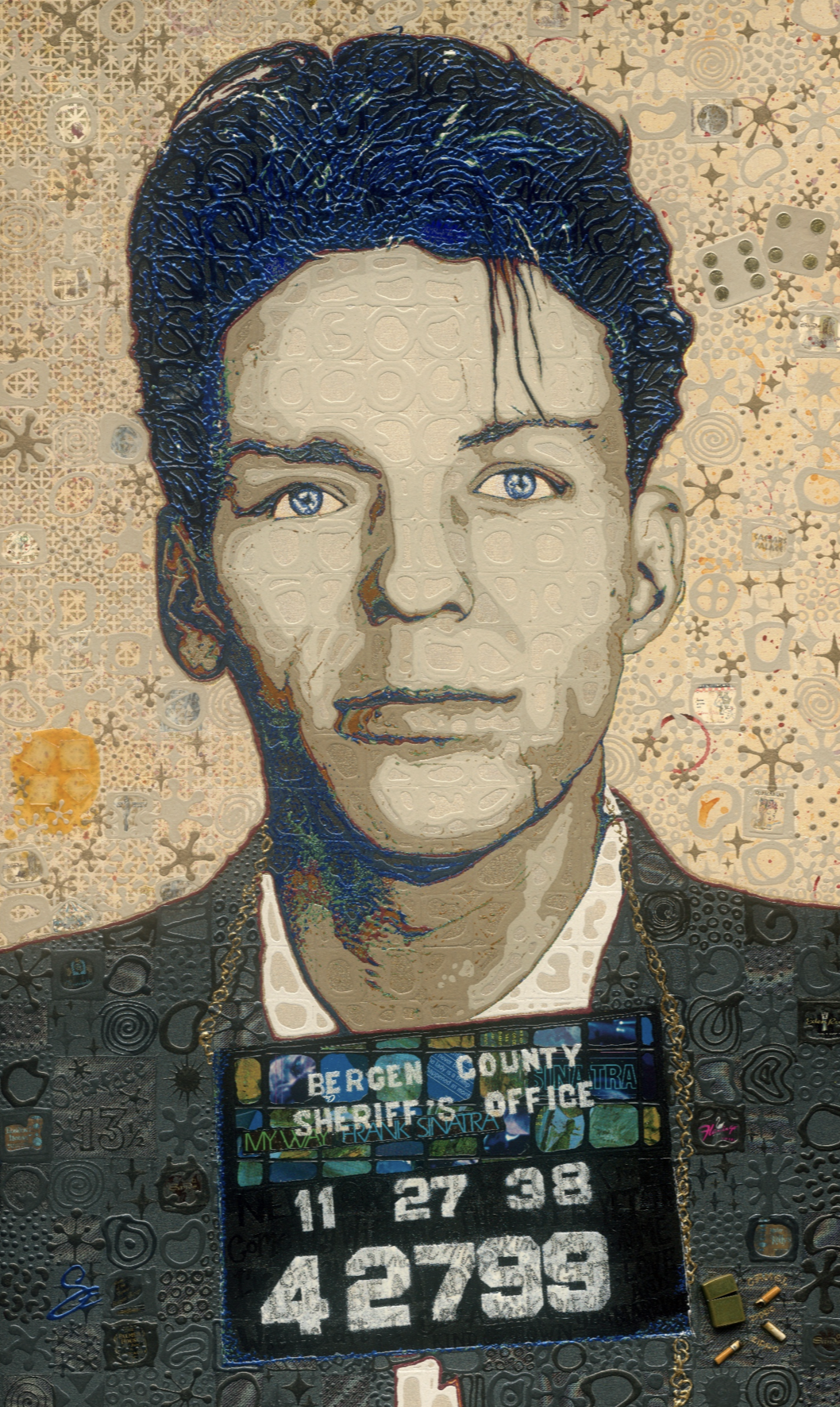
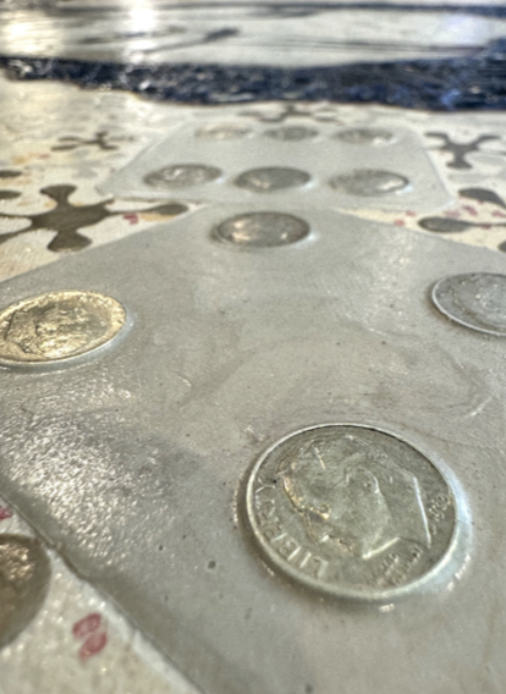
You depict a lot of icons, with “winks” to the little things that make them unique- like the ten dimes on your take on Frank Sinatra. What does that research process look like? How do you decide what the “winks” will be?
A blessing and a curse. Especially with the Pop Art icons, I want to get to know them. I want to feel like they may have been a part of the process, that they shared some personal insight I can weave into their story. And I want my works to reveal something, to give the viewer a reason to look closer. Many people know Sinatra had a chip on his shoulder, that he liked to play the tough guy, but few know the origins of that came from childbirth. He was a 13.5 lb. baby who nearly killed his mother during birth, and in his early years all he heard was how big he was - then he grew to 5'7" and 145 lbs. The dimes are about a very real, very personal experience in 1962, searching for dimes in a casino so he could talk on a pay phone to the kidnappers who had taken his son, Frank Jr. Everything worked out, but it was a life-altering experience. He never left the house again without 10 dimes in his pocket. That says a lot about the man, way beyond the songs and the movies.
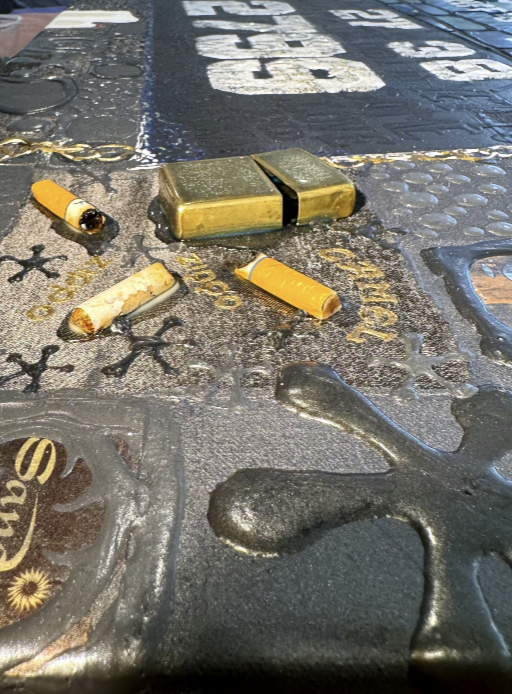
A traceable theme of current Eichler pieces seems to be a use of mixed media ranging from acrylic to hand-dyed bandanas to velvet scraps and a medium akin to puffy paint. Is there a medium you would like to experiment with, and haven’t gotten to yet? A surface you’d like to interpret as a canvas?
I've used lots of textiles, memorabilia, real used cigarettes, vintage records, many items that move the story forward. I've worked with wood several times and love letting the grain become a part of the composition and story. I did a series of musicians inspired by their favorite guitars, matching the grains and details of the instruments to the panels, including the radius of the guitar on one corner. Sheryl Crow got a Sitka spruce face with red mahogany sides to match her Gibson Country Western acoustic, the one she called her "Money Maker." Because of all the heavy texture, my work already takes on a sculptural quality, so the next natural step would be actual wood sculpture. Metal is certainly interesting, and I have a fascination with concrete - so who knows what's next.
Your career is still new, and you’ve already pivoted from surrealism (Distant) to true abstract expressionism (Hard Candy Crossroad) to Photo-Realistic portraits (JIMI) with subtle abstract elements. Do you have any idea what the next shift might be, if there is one?
I find each piece inspires ideas for the next. It's a little unstructured and organic and I like it that way, so I won't know until I get there. I don't know if it's exposing a little of my secret sauce, or maybe my "crazy," but I like to imagine these epic collaborations in my mind. Kind of like that hypothetical dinner party question: if you could invite five people from throughout history, who would they be? When I start on a new journey, I bring together a group who inspire me. I love process, finding new ways to paint and create, so they are often artists who created work not just by what they painted but how they painted - who experimented and broke rules and strict technical boundaries. It pushes me. When I decided I was going to do a painting made of bandanas, having the right people in the room inspired me to figure out how.
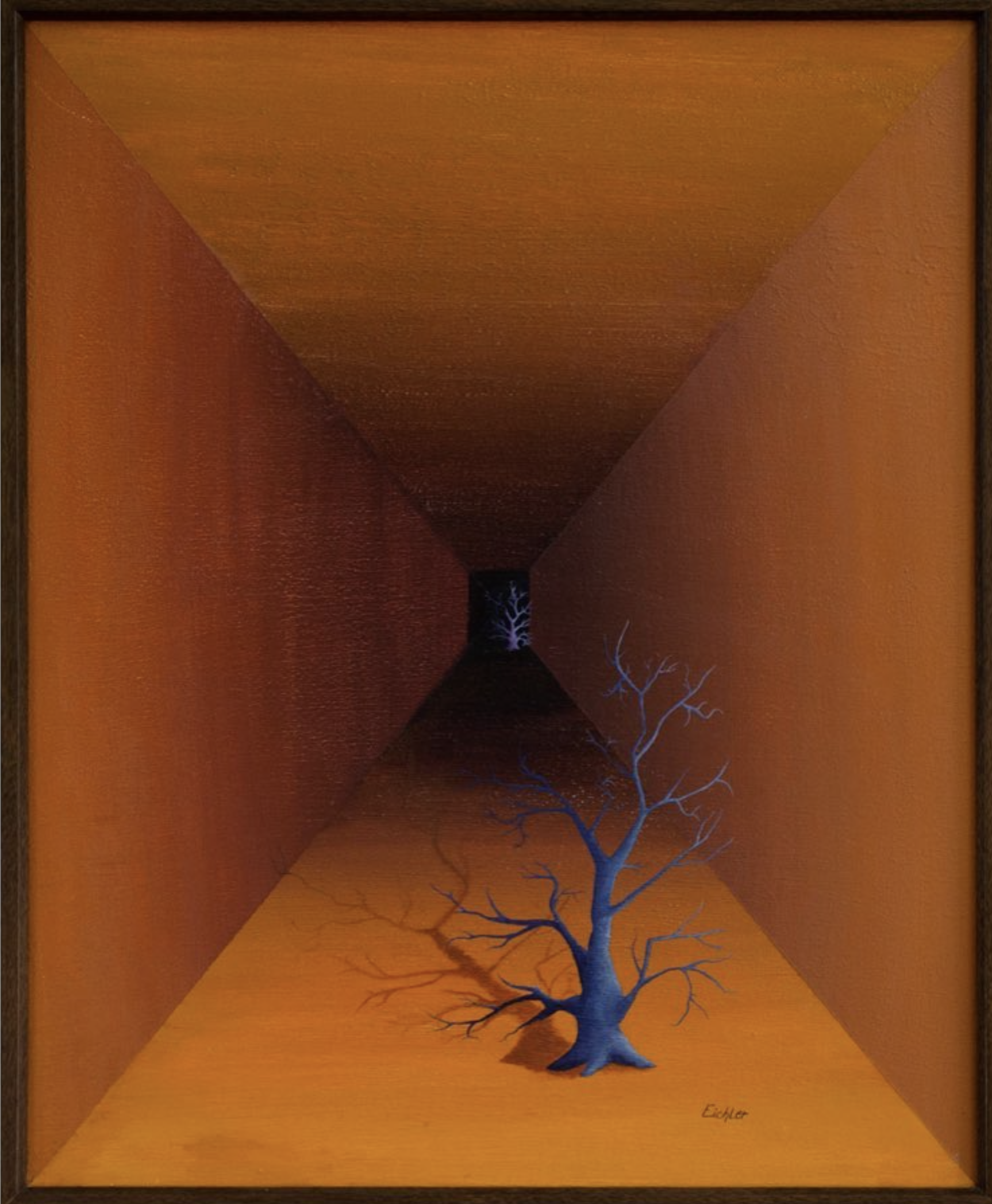
You’ve listed Rothko, Magritte, Kasuma and Warhol as influences, just to name a few. Aside from these big names, are you keeping up with any smaller contemporary artists? Who, and what draws you to their work?
One of the benefits of social media is that you get exposure to so many other artists and the extraordinary work some are doing. There is Nina Tichava from Santa Fe, who I think does amazing work - very layered and process driven. I went to a gallery show she did in Dallas and her work is so beautiful in person. You really see the effort and nuance she achieves. I also love Helen Booth's work, an artist out of Wales who does these extraordinarily serene paintings: very minimal, using a spare color palette with repetitive simple organic lines and shapes. To keep my collaboration fantasy alive, Helen Booth paints in a way that looks to me like what a collaboration between Agnes Martin and Yayoi Kusama might have looked like. I saw Sonya Clark at an exhibition here in Atlanta a couple of years ago at the High Museum. Just a brilliant mind - the powerful statements she makes with minimal installations are remarkable.
You’ve lived in most of the major cities in the United States. If the opportunity arose to move somewhere new, where would you go? Somewhere international? Stay right here? Why?
I've only been in Atlanta for a few years, so I'm still enjoying it right where I am. I traveled a ton in my early career, all throughout Europe and Asia. I always enjoyed the Scandinavian cities like Copenhagen and Stockholm, and while not Scandinavian, I just love Amsterdam. On the other hand, I love the desert. The high deserts of Santa Fe and Sedona would be fabulous, and because of my passion for modernism, Palm Springs or even Joshua Tree. As I am married to a woman who considers anything below 60 degrees blizzard conditions, it will likely be Palm Springs.
You portray icons of history that were themselves activists in their own right. How does your own activism come across in your style? Is it important for other artists to be activists, or are all artists inherently activists?
I've never seen myself as an activist, but I'm drawn to people who have an intellectual curiosity - those who can see around corners and aren't afraid to carve a new path. I think the greats continuously seek enlightenment and are just patiently pulling the rest of us along to a place of deeper understanding. If that is the definition of "woke," show me where the line is to get in.
You can come see Scott Eichler’s work at Gallery Anderson Smith in Midtown Atlanta now, or by appointment.
Written by Camilla Schiappa May 12, 2026.